Author: Nate Kreichman (Page 2 of 2)

As I Go Along: The Sandman #4 “Seasons of Mist”

Note: “As I Go Along” is a weekly feature in which I review and discuss the best graphic novels and series that I haven’t yet had a chance to read. These are the titles your comic-loving friends have been trying to push into your hands for years, only now I’ll be doing the pushing (or telling you not to bother). The post will include spoilers for those who have not yet read the work.

“To absent friends, lost loves, old gods, and the season of mists; and may each and every one of us always give the devil his due.”

After a bit of a wait, the latest collection of “The Sandman” I’ve gotten to put the focus back on Dream as the central character, with, of course, a few of Neil Gaiman’s trademark jumps elsewhere mixed in. “Seasons of Mist” begins with Destiny, the oldest of the Endless, calling a “family meeting.” One member is absent, and although we don’t know anything about he/she/it yet, other than that it is sometimes referred to as “the prodigal,” I’d wager its name starts with “d” (the six members present are Death, Destiny, Dream, Desire, Delirum, and Despair).

The happy family reunion quickly turns into a family argument, as Desire tells Dream he was wrong in sending Nada to Hell for thousands of years. Recall that we saw Dream walk past his former lover during his first trip to the underworld, and that we got the full story of their relationship in the prologue of “The Doll’s House.” Dream is outraged, until in a private conversation, Death says, “condemning her to eternity in hell, just because she turned you down… That’s a really shitty thing to do.”

Think about that, the Endless, the only immortal beings in the universe, use language as colloquial as “really shitty thing to do.” Well, Death does anyway. But it’s these kinds of odd juxtapositions that make “The Sandman” so great. Anyway, the argument leads to a sequence of events that make up the bulk of the major story arc: Dream returns to Hell only to find Lucifer is busy closing it down. It seems Satan is done ruling the underworld, and he puts Dream in charge of figuring out what the hell to do with the place (see what I did there?). As such, the story sets out to answer one question: What would happen if Lucifer up and left? Or, storytelling being what it is, what would you do if you had to decide who to give the key to Hell to? Dream ends up putting a couple of angels in charge despite the pleas of a plethora of deities, demons, and demi-gods (shit, Gaiman’s got me doing the d thing now). Of course, Destiny knew that was going to happen along, it’s kind of his thing.

The main story in “Seasons of Mist” was fantastic, but my favorite issue in the collection was doubtless one of those trademark jumps. It’s the fifth story, “”In Which the Dead Return; and Charles Rowland Concludes His Education.” Charles Rowland is left at his boarding school when most everyone else has gone home. Unfortunately for Charles, this happens to be at the same time Lucifer has kicked the dead out of hell, so those that died at the school (or just didn’t have anywhere else to go) return to haunt it.

Early on, Charles sits in front of a memorial for the boys from his school that died during the “Great War.” Two of those boys end up returning to St. Hilarion’s to torment Charles. He’s rescued by one Edwin Paine, who just so happened to have died when the same boys sacrificed him to the devil in 1914. The boys thought they would get special treatment in Hell because of their actions, “but when we went to Hell… They didn’t even care. They hadn’t even known. They–they laughed at us.”

Charles ends up dying, but Death’s far too busy to take him. Charles and Edwin decide they’ve learned all they’re going to at school and leave. Although they’re dead, they plan to “see what life’s got to offer.”


As I Go Along: The Sandman #3 ‘Dream Country’

Note: “As I Go Along” is a weekly feature in which I review and discuss the best graphic novels and series that I haven’t yet had a chance to read. These are the titles your comic-loving friends have been trying to push into your hands for years, only now I’ll be doing the pushing (or telling you not to bother). The post will include spoilers for those who have not yet read the work.

“Things need not have happened to be true. Tales and dreams are the shadow-truths that will endure when mere facts are dust and ashes, and forgot.”

In more ways than a few, “Dream Country” differs from the two collections that preceded it. The four issues it contains are not “chapters” in a story line in the way those of “Preludes and Nocturnes” or “The Doll’s House” were, as they are independent of the overarching “Sandman” tale. “Dream Country” would be more aptly compared to a collection of short stories than a novel, but those of us who have read Gaiman’s short fiction know that’s not necessarily a bad thing.

However, just because these stories are unrelated to the overarching plot doesn’t mean they’re not self-referential and chock full of Gaiman’s trademark intersection.

Much like in “The Doll’s House,” the theoretical protagonist, Dream, took a backseat in “Dream Country.” In fact, Dream doesn’t even appear in the final issue, “Facade,” but that’s more than made up for when Death, his spunky older sister, shows up.

The first story, “Calliope,” centers around Richard Madoc, a novelist suffering from writer’s block. Madoc trades a trichonobezoar, a hairball found in the intestine of someone with Rapunzel Syndrome, for Calliope, the muse of epic poetry in Greek mythology. At its outset, this appears to be another “be careful what you wish for” cautionary tale. But Gaiman being Gaiman, it’s turned into so much more.

More than anything else, “Calliope” is a story about human nature, and as a result, greed. In mythology, the best way to get a muse to grant an artist inspiration was to woo her; to be humble and gracious, thankful for any and everything she grants. Erasmus Fry, from whom Madoc gets Calliope, had no time for such things. “They say one ought to woo her kind, but I must say I found force most efficacious.” Like Fry, Madoc rapes his muse, justifying his actions because his second novel is nine months overdue. Neither writer had time for courtship. In effect they said, “give me inspiration, or else.”

Of course, as was the case with Fry, a second successful novel was not enough for Madoc. Nor was a third, or a poetry collection, play, or a deal to write and direct the film adaptation of one of his books. The film gets nominated for three Oscars, by the way. For Madoc, as with any human being given absolute power, inspiration, or anything else, it will never be enough.

Enter Dream, who puts an end to all that. He floods Madoc with so many story ideas that it drive the writer insane, compelling him to release Calliope. Similarly, Fry is found dead, supposedly poisoned, despite the fact that bezoars are meant to protect against any poison.

Dream’s actions display the way he changed and matured during his imprisonment, which occurred largely at the same time as Calliope’s. We learn that Dream and the muse once had a relationship which resulted in a son, the mythological figure Orpheus. Now, we know Dream can hold a real good grudge. After all, Nada, is still in hell. Both Calliope and Dream note his maturation, the former says, “You have changed Oneiros. In the old days, you would have left me to rot forever, without turning a hair,” before asking, “Do you still hate me? For what I did?” Dream responds, “No, I no longer hate you Calliope. I have learned much in recent times and… No matter. I do not hate you, child.”

It’s pretty incredible that there’s so much room for growth in the saga of one of the seven immortal beings in the universe. Remember, in this diegesis, even gods can die when the living stop believing in them. As Chuck Palahniuk put it in “Fight Club,” “On a long enough timeline, everyone’s survival rate drops to zero.” In “Facade,” Death explains this is true even of the seven Endless, saying “When the first living thing existed, I was there, waiting. When the last living thing dies, my job will be finished. I’ll put the chairs on the tables, turn out the lights and lock the universe behind me when I leave.”

It seems Dream’s development will continue in the next collection. The synopsis for “Seasons of Mist” indicates that Dream travels to Hell to free Nada after millennia of incarceration and torment. We’ll just have to wait and see whether or not that means he’s forgiven her. I know I’m excited.


As I Go Along: The Sandman #2 ‘The Doll’s House’

“Was he really there at all? When you try to remember him he fades and shimmers until he seems little more than the echo of a dream.” – Rose Walker, “Into the Night”

The tremendous amount of continuously intersecting story lines within “The Sandman” was on full display in the first issue in the “Doll’s House” collection, “Tales in the Sand,” which serves as prelude to the “Doll’s House” narrative proper. The frame story shows an old man in an African culture taking a younger man into the desert to tell him a story as part of a manhood ritual. The tale the old man tells is of “a pair of star-cross’d lovers,” Nada and Dream (Gaiman gets his Shakespeare references in, so I figure I’ll get mine).

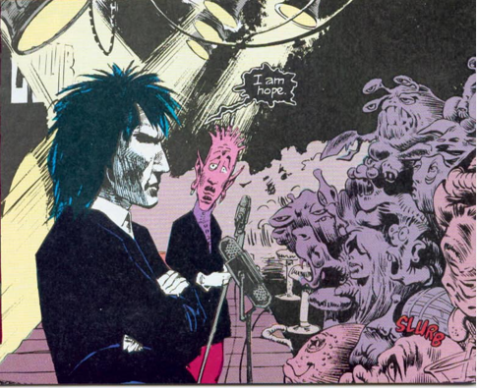
The woman fears the ramifications of engaging in a relationship with an immortal and spurns Dream. In his subsequent Anger, Dream sends Nada to Hell, where she remains to this day. How do we know this? We saw him walk by her cell in issue #4, “A Hope in Hell.” At the time, it seemed like a bit of a random exchange, but it turned out Gaiman had Tarantino’d us, showing the end of the story ten thousand years after it began. Although saying he Tarantino’d it isn’t really fair, as these issues came out years before “Reservoir Dogs” or “Pulp Fiction.”

Of course, the intersections and criss-crossing don’t end there. One of the things that sets “The Doll’s House” apart from the series’ first collection is that while Dream is still the focal point, he’s “off-camera” more often than not while the story focuses on another character, Rose Walker. Who is Rose Walker? Well, all the way back in the very first issue, a woman named Unity Kinkaid fell victim to the sleeping sickness that occurred while Dream was imprisoned. While she was asleep, Unity was raped and gave birth. The baby, named Miranda, was adopted, and when she grew up she gave birth to one Rose Walker.

As if that wasn’t enough explanation of the intersections, I’ll continue. While the previous two examples were callbacks to events and characters from the first collection, the entire “Doll’s House” plot line is actually three intersecting stories that come together at the end, as intersecting stories tend to do.

The first story line is that surrounding Unity, Miranda, and Rose. Having awoken, Unity uses her fortune to hire a private detective to bring her long-lost daughter and granddaughter to England. Meanwhile, Dream takes a census of his realm and discovers four of his creations are missing, so he embarks on a quest to find them. Two of those creatures, Brute and Glob make up the third story line. The two have escaped the Dreaming and taken residence in the mind of a boy named Jed. Jed who? Why, Jed Walker of course, who had been in the care of Rose’s deceased father. Upon their father’s death, Jed was sent to live with some abusive relatives, who lock him the basement and basically only want him around for the $800 government check they get each month. While Miranda stays in England to care for London, Rose returns to America to search for her brother.

Perhaps my favorite issue in the collection was one that wasn’t even related to the main story arc. In issue number 13, “Men of Good Fortune,” we see Dream grant a man named Hob Gadling immortality and subsequently meet him in an East London inn once every century.

In most immortality stories, the recipient soon recognizes the folly of his ways and starts begging for death’s embrace. This is not so for Hob Gadling. Through Dream’s eyes, we see Gadling rise and fall as the centuries pass by. He becomes wealthy, gets married and earns a knighthood. His wife dies, he picks the wrong side in a war, and becomes a penniless disgrace. He gets rich a second time when he enters the slave trade, but leaves it once Dream shows him its immorality.

As we watch Gadling and Dream interact throughout the centuries, we see that there’s an awful lot that never really changes. We see conversations in which the bar’s patrons argue whether or not AIDS (in 1989) or the bubonic plague (in 1389) are punishments from God, and discuss poll taxes instituted by both King Richard II and Margaret Thatcher. But we also see how things change. For example, Hob points out that although she was Queen consort of England, Catherine of Aragon was technically black. As such, Hob notes “if Catherine of Aragon had lived in Alabama in 1950, she would have been at the back of the bus.”

The thing that struck me most about this collection (besides all the wonderful intersections of course) is the way it humanizes Dream. While he may be a member of the Endless, who are the only immortal beings in the galaxy (that’s right, even gods dies when people stop believing in them), he feels emotions like love, remorse, loneliness, and betrayal, just like the rest of us. He meets Hob Gadling once a century for a chat, at first under the auspices that granting the man immortality will “amuse” him. But in 1889, Hob call Dream out, saying they only meet because Dream is lonely, because Hob is his only friend. Dream walks out in disgust, but a century later he returns to say, “I have always heard it was impolite to keep one’s friends waiting.”


As I Go Along: The Sandman #1 ‘Preludes and Nocturnes’

Morning announcements: “As I Go Along” is a new weekly feature in which I will review and discuss the best graphic novels and series that I haven’t yet had a chance to read. These are the titles your comic-reading friends have been trying to push into your hands for years, only now I’ll be doing the pushing (or telling you not to bother). Ill be starting with the first volume of Neil Gaiman’s The Sandman, entitled “Preludes and Nocturnes.” Since this is the first one, there will be only minor spoilers, future posts will assume familiarity with the previous collections.

“People think dreams aren’t real just because they aren’t made of matter, of particles. Dreams are real. But they are made of viewpoints, of images, of memories and puns and lost hopes.”

Neil Gaiman is about as famous as a writer can get these days, and he’s won a veritable plethora of awards to boot. The story goes that in the late 80s,  Karen Berger, who’s now the executive editor of Vertigo, read Gaiman’s work and offered him a job rebooting an old character, The Sandman. Gaiman’s version, who goes by many names, including Dream and Morpheus,  is closer to that of mythology and fairy tales than his superhero predecessors. The character rules over all dreams and stories, essentially anything that isn’t “reality.” But he’s less a God and more an ageless anthropomorphic personification, the embodiment of the concept of dreams.

Everyone (by which I mean the Internet) keeps telling me that “Preludes and Nocturnes” is far from the strongest title in the series, both Gaiman and the editor say as much in the foreword. I’m only halfway through the second collection so I can’t speak to the veracity of that notion, but I enjoyed the hell out of “Preludes and Nocturnes,” so if that’s the case I’m beyond excited to see what’s to come.

The story begins in 1916, an occult group led by Roderick Burgess is attempting to capture Death to gain immortality. Burgess is a magician akin to Aleister Crowley, in fact in the DC Universe, Burgess is Crowley’s rival. Burgess’ plan goes awry and he captures Dream, Death’s little brother, instead. After being imprisoned for centuries, Dream escapes, seeks vengeance, and begins hunting down the tools that make him powerful.

What follows will be familiar to gamers,  it’s basically a fetch quest which serves as an extended, but necessary, introduction to the expansive world(s) in which Dream operates. He needs to reclaim his pouch of sand, helm, and ruby, and his quest takes him everywhere from Arkham Asylum, Justice League Headquarters, Hell, and his own realm, called “the Dreaming” (what else?).

Highlights include the first issue, detailing Dream’s imprisonment, his trip to hell and participation in a certain “game,” and the last issue, which serves as a sort of epilogue and shows Dream following his older sister Death around for a day. You won’t believe what she’s like, but you’ll love it.

Most of the complaints, namely that Gaiman was trying too hard both to fit his tale into the horror genre and the more overarching DC Universe, are valid. Along the way we see characters like Martian Manhunter, the Scarecrow and John Constantine (the guy Keanu Reeves played). I didn’t mind that stuff, but I could see it getting tiresome. However I’m told such appearances become infrequent, so it will become less of an issue as the series goes on.

It seems the best is yet to come, but “Preludes and Nocturnes” is still a highly enjoyable read. It’s clear Gaiman had a vision from the start. From halfway through the second edition, “The Doll’s House,” it’s apparent that there is a nigh unbelievable amount of foreshadowing and intertwining story lines. As a result of this and Gaiman’s writing, which is chock full of references, you might find it helpful to keep this page bookmarked. It’s an annotation of each issue, explaining references, reminding you of characters you forgot were introduced, etc. But wait until you finish the issue before reading the annotations, as there are spoilers.

Movies you should, but don’t need to see before ‘The Avengers’


They’re famous for their battle cry, news team, er, I mean, “Avengers, assemble!” Well, it’s finally happening, Joss Whedon’s “The Avengers” is coming out on Friday. The film, which has already grossed over $200 million overseas, is both the beginning of a franchise and the culmination of one. Marvel has been building towards this movie with post-credit scenes, cameos, and hints since 2008. As such, there are a few other movies you’ll want to check out to get the whole story. I’ll offer a quick rundown of them here, and the bold name at the top of each will link to its Bullz-eye review. If you’ve already seen them all and want an in-depth refresher on the hints, I highly recommend this post at Tor.com.

The great thing about about this little homework assignment is that all these movies are worth watching for their own sake. With the exception of “The Incredible Hulk,” each and every one has been “certified fresh” on Rotten Tomatoes. Whether or not that will be the case for the barrage of sequels that is soon to follow remains to be seen, but a man can dream.

Iron Man (2008)

This is where it all started. “Iron Man” is the story of billionaire playboy/industrialist/engineer Tony Stark, whose expert portrayal by Robert Downey Jr makes the film. Stark Industries is a high-tech weapons manufacturer. When the film begins, Tony is on a business trip in Afghanistan, where he’s wounded in a terrorist ambush. As he passes out he sees his company built the missile that did the damage. He’s kidnapped, builds a super suit, escapes, yada yada yada, before he’s back with a mission: preventing Stark Industries from selling any more weapons. “I have more to offer the world,” he says, “than making things blow up.” That’s when the real conflict begins.

Now, my biggest problem with superhero movies is that they always start with the origin story. That’s not how it happens in the comics, it can take years before we hear how so and so got his powers. But any writing teacher will tell you that you can break every rule in the book, as long as you do it right. “Iron Man” doesn’t so much break the rule as make you wonder why it’s a rule to begin with. No other Marvel film has handled an origin story quite so well.

While “The Avengers” will definitely come close, “Iron Man,” with its 94 rating on the Tomatometer, is the best Marvel adaptation so far and one of the best superhero movies of all time. Few films, let alone superhero films, are better than Christopher Nolan’s Batman reboots, but if they didn’t exist “Iron Man” would easily top the list.

Iron Man 2 (2010)

The sequel isn’t as good as the original, for a change. However, “Iron Man 2” is still a damn good movie. We’ve already seen Iron Man’s origin and Stark’s redemption, so it’s replaced by plenty of great action, and if nothing else, the film offers an excuse to give us more of Robert Downey Jr. in a role he was seemingly born to play.

The filmmakers recognized the inherent problems of sequel-making and addressed them head on. That self-awareness helped the finished product. For example, Don Cheadle replacing Terrence Howard could have been a big issue if they tried to sweep it under the rug. Instead, Cheadle’s first line, “It’s me, I’m here, deal with it and let’s move on,” calls attention to the change. This move gives the viewer no other choice but to do as he says and move on.

Stark has revealed his identity and been thrust into dispute with the U.S. government, which is “not exactly thrilled by the idea that a private citizen has been able to achieve world peace almost single-handedly, and instead want to militarize the technology for their own benefit.” Tony is also forced to battle with an army of Iron Men created by Russian physicist Ivan Vanko (Mickey Rourke), who’s teamed up with rival arms manufacturer Justin Hammer (Sam Rockwell). Two characters central to “The Avengers,” Black Widow (Scarlett Johansson) and Nick Fury (Samuel L. Jackson) also get their first extended screen time.

The Incredible Hulk (2008)

“Hulk” is the worst film on the list, and the least necessary for understanding “The Avengers.” The 2008 film, which stars Edward Norton as mild-mannered scientist Bruce Banner, was an attempt to reboot the series following the disappointing 2003 version, which starred Eric Bana in the same role. Never fear, Mark Ruffalo has just signed a six-picture deal to play the Hulk.

Anyway, Banner is travelling the world trying to find the antidote to his condition. Of course, neither war profiteers who want to exploit him nor his supervillainous enemy The Abomination (Tim Roth) are quite OK with that. Since the Hulk is in “The Avengers,” it’s a fair guess Banner never finds that antidote. “Hulk” is a good film and well worth seeing, but it should be last on your list of pre-Avengers priorities.

Thor (2011)

“Thor” was directed by Kenneth Branagh, who I know best as “that Shakespeare guy,” and stars Chris Hemsworth in the title role. At first glance, the movie is a hard sell. Thor is a Norse thunder god from the fictional realm of Asgard. Contrast that with the other “Avengers” characters, who are mostly American, let alone Earthlings.

When he disobeys a command from his father, Odin (Anthony Hopkins), Thor is stripped of his magical hammer and banished to Earth, where he meets astrophysicist Jane Foster (Natalie Portman). Before long, Thor’s brother Loki (Tom Hiddleston), who’s been causing trouble back in Asgard, starts wreaking havoc on Earth as well. Believe it or not, epic god battles ensue. Loki returns as the main villain in “The Avengers.”

“Thor’s” release marked when the “Avengers” hype really started to take shape. The film finds a nice middle ground for connections between the two. While they’re certainly present, they aren’t given nearly as much screen time as they were in “Iron Man 2,” which is probably a good thing. Too many hints and such can bog down the story and prevent the film from being worthwhile for its own sake. Thor walked the line admirably.

Captain America: The First Avenger (2011)

Now things are really heating up, after all it’s right there in the title, Captain America is “the First Avenger.”

“Captain America” opens in the present day, with a S.H.I.E.L.D. team discovering the hero’s frozen body. Back in the 1940s, the U.S. has just entered into World War II. But the man won’t let Steve Rogers (Chris Evans) enlist because he’s too small. Eventually Rogers is offered a position in a secret super soldier program, and even after it’s a success they still won’t send him to battle. Instead, he’s used as a pitchman for war bonds. Rogers takes it upon himself to investigate Nazi scientist Johann Schmidt (Hugo Weaving) and end the war once and for all.

There’s all kinds of “Avengers” stuff floating around “Captain America.” Tony Stark’s father Howard is heavily involved in the super soldier program, and a big part of the plot revolves around the villains attempting to get the cosmic cube, an all powerful something that might just be able to open a portal to Asgard.

Newer posts »